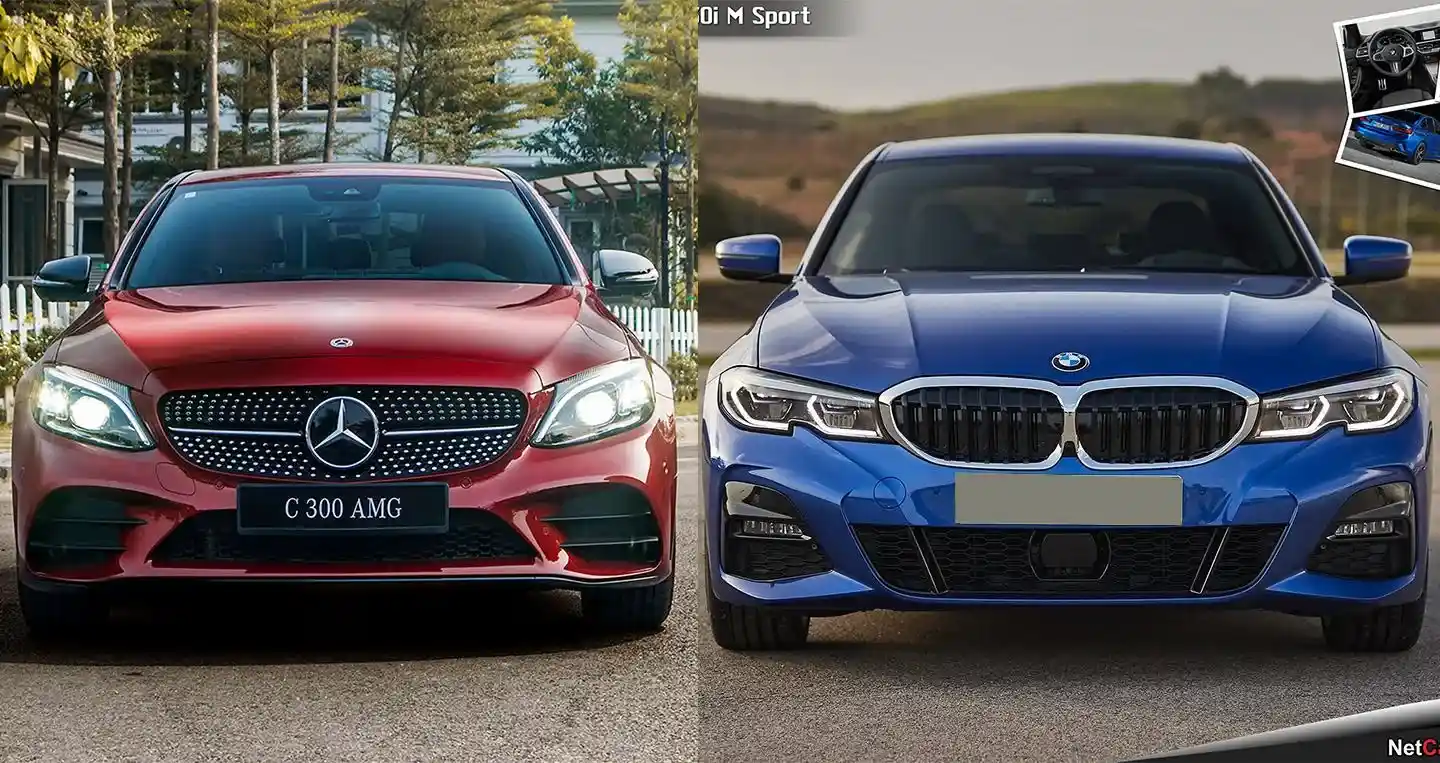
The mercedes c300 vs bmw 330i remain two of the strongest contenders in the entry-level German luxury sedan segment. Both deliver refined powertrains, premium interiors, and advanced technology, yet they pursue different priorities. The BMW emphasizes sharp driving dynamics and practicality, while the Mercedes prioritizes comfort, isolation, and a more opulent cabin feel. This detailed comparison of the current Mercedes C300 vs BMW 330i examines performance, handling, interior, technology, efficiency, pricing, and ownership to help buyers decide which better matches their needs.
Performance and Powertrain: Close Numbers, Different Characters
Both cars use a 2.0-liter turbocharged inline-four with 48-volt mild-hybrid assist. Output is identical on paper: 255 horsepower and 295 lb-ft of torque. The BMW pairs its engine with an eight-speed automatic, while the Mercedes uses a nine-speed unit.
Real-world results favor the BMW. The 330i is lighter (around 3,644 lbs versus the C300’s roughly 3,825 lbs) and typically accelerates from 0-60 mph in 5.3–5.6 seconds. The C300 trails slightly at about 5.7–6.0 seconds. The BMW feels more eager and responsive, with sharper throttle response and quicker shifts. The Mercedes prioritizes smoothness and refinement—the power delivery is polished and linear rather than aggressive.
Fuel economy also edges toward the BMW. EPA estimates for the rear-drive 330i commonly read around 28 city / 35 highway / 31 combined mpg, versus the C300’s roughly 25/35/29. All-wheel-drive versions (xDrive and 4MATIC) narrow the gap but still leave the BMW slightly more efficient in most comparisons.
Handling and Ride Quality: Driver’s Car vs Cruiser
This is where the philosophical split becomes clearest. The BMW 330i delivers precise steering, balanced chassis dynamics, and composed body control. It feels agile and engaging on winding roads, rewarding drivers who enjoy feedback and involvement. Ride quality is firm yet controlled—supportive without becoming harsh on typical roads.
The mercedes c300 vs bmw 330i takes the opposite approach. Its suspension prioritizes comfort and isolation. The ride is softer and more compliant, soaking up imperfect pavement with greater composure. Cabin noise levels are often lower, creating a more serene long-distance experience. Steering is lighter and less communicative. Enthusiasts generally prefer the BMW; buyers seeking a relaxed daily driver or frequent highway miles often lean toward the Mercedes.
Interior, Space, and Practicality
Both cabins feel premium, with high-quality materials, ambient lighting, and strong attention to detail. The Mercedes typically wins on pure luxury ambiance—softer seats, more elegant surfaces, and a quieter, more insulated environment. Rear legroom is marginally better in the C300 (about 0.8 inches more in some measurements).
The BMW counters with better packaging. Front seats are firmer and more supportive for long drives or spirited cornering. Cargo space is a clear BMW advantage: roughly 16.9–17 cubic feet versus the C300’s approximately 12.6 cubic feet. The 330i’s trunk is more usable for luggage, groceries, or weekend trips despite the cars’ similar exterior footprints.
Technology and Infotainment
Both offer sophisticated digital cockpits. The BMW features a large curved display (commonly a 12.3-inch instrument cluster paired with a 14.9-inch central touchscreen) running the latest iDrive system. It is highly responsive, with strong smartphone integration and available augmented-reality navigation.
Mercedes counters with its MBUX system, often featuring a prominent portrait-oriented central screen and a high-resolution digital cluster. Voice control is particularly strong (“Hey Mercedes”), and the interface can feel more futuristic to some users. Both support wireless Apple CarPlay and Android Auto, advanced driver aids, and extensive customization. Preference often comes down to interface style rather than raw capability.
Safety, Reliability, and Ownership Costs
Both models typically earn top safety marks, including five-star NHTSA overall ratings where tested, with comprehensive standard and optional active safety suites (automatic emergency braking, lane-keeping, blind-spot monitoring, adaptive cruise, and more).
Reliability data is competitive. Independent assessments often show the BMW 3 Series with a slight edge or parity in recent years, though individual ownership experiences vary. BMW frequently includes complimentary scheduled maintenance for the first few years/miles on many models, while Mercedes typically offers it as a paid option. This can lower real-world ownership costs for the 330i. Insurance and residual values are generally close, with the BMW sometimes showing modestly stronger resale in certain markets.
Pricing and Value
Base MSRPs are closely matched, with the mercedes c300 vs bmw 330i often starting a few thousand dollars lower than the equivalent C300 (recent figures place the 330i near $46,000–$48,000 and the C300 near $48,000–$50,000, depending on model year and options; AWD versions add roughly $2,000 on both). Well-equipped examples with popular packages (M Sport or AMG Line, premium audio, advanced driver assistance) climb into the mid-$50,000s.
The BMW frequently delivers better overall value through lower starting price, superior efficiency, more cargo space, included maintenance on many examples, and stronger driving engagement. The Mercedes justifies its premium through superior ride comfort and cabin luxury for buyers who prioritize those traits.
Final Verdict
Choose the BMW 330i if you want the more engaging drive, better fuel economy, greater practicality, and stronger value. It remains the sharper tool for enthusiasts and drivers who enjoy the road.
Choose the Mercedes C300 if comfort, quietness, and a more luxurious, relaxed cabin experience matter most. It excels as a refined daily cruiser and long-distance companion.
There is no absolute winner—the right choice depends on whether you prioritize driving involvement or serene luxury. Test-drive both back-to-back on the same roads; the difference in character becomes immediately apparent. Both represent excellent examples of modern German compact luxury engineering and will satisfy owners who match the car to their priorities.


One thought on “Mercedes C300 vs BMW 330i: Which Wins in 2026?”