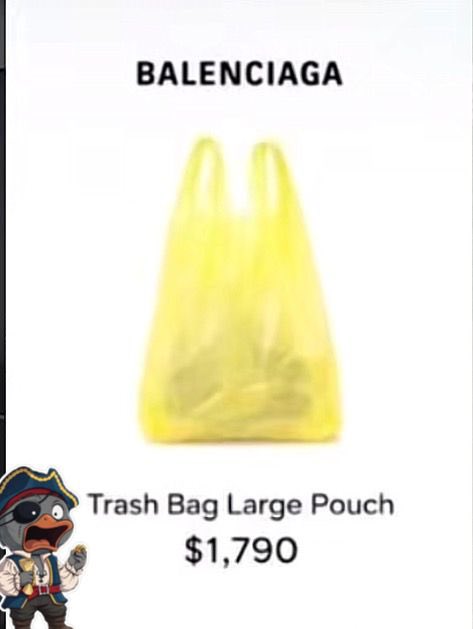
In the world of luxury fashion, few items have generated as much debate, laughter, and fascination as the Balenciaga Trash Bag. Officially known as the Trash Pouch, this accessory debuted on the Fall/Winter 2022 runway under creative director Demna Gvasalia. Crafted to resemble an ordinary plastic garbage bag yet priced at nearly $1,800, it perfectly embodied the brand’s talent for transforming the mundane into the extraordinary—and for provoking strong reactions.
The Design That Sparked Global Conversation
The Trash Pouch is made from soft calfskin leather finished with a glossy coating that mimics the sheen and crumpled texture of a standard kitchen trash bag. It features a simple drawstring closure, subtle branding, and an interior that includes practical details such as a zippered pocket. Available in colors like black, white, blue, and yellow, the bag was designed to look almost identical to disposable plastic sacks sold in supermarkets for a few cents.
Demna has openly stated that creating the world’s most expensive trash bag was intentional. He viewed it as an opportunity to generate the kind of fashion scandal that keeps the industry talking. The piece first appeared during a dramatic Paris Fashion Week show set against artificial snow, a presentation that also carried deeper emotional undertones related to displacement and conflict. Models carried the bags in a way that evoked people transporting belongings under difficult circumstances, adding layers of meaning beyond pure provocation.
This was not Balenciaga’s first experiment with everyday objects elevated to luxury status. Earlier, the house had released a leather version of the iconic blue IKEA Frakta shopping bag, which sold for over $2,000. The Trash Pouch continued that tradition of questioning value, status, and the boundaries of what can be considered high fashion.
Materials, Craftsmanship, and Practical Details
Despite its humble appearance, the Trash Pouch is a carefully constructed luxury product. The calfskin is selected and treated to achieve both flexibility and the distinctive shiny, slightly irregular surface that replicates plastic. Unlike an actual garbage bag, it includes structural elements that allow it to function as a wearable accessory. Removable handles and a drawstring system provide versatility in how it can be carried.
The attention to detail extends to the interior lining and finishing, ensuring durability that far exceeds anything found in a real disposable bag. Owners report that the leather develops character over time while maintaining its intentional “trash-like” aesthetic. This combination of high-end materials and deliberately lowbrow inspiration is central to Demna’s approach at Balenciaga during his tenure.
Public Reaction and Cultural Impact
When the Trash Pouch became available for purchase in mid-2022, social media erupted. Critics mocked the price, comparing it to kitchen Hefty bags and questioning the excesses of luxury fashion. Memes proliferated, with users joking about being “Balenciaga trash bag rich.” At the same time, the item sold out quickly, demonstrating that controversy often fuels desirability in this sector of the market.
Celebrity association amplified the conversation. Kim Kardashian received one of the bags after the runway show and shared her excitement on Instagram, further boosting visibility. The piece joined a long line of Balenciaga designs that deliberately challenge conventional notions of beauty and utility.
Years later, the bag continues to surface in cultural discussions. In early 2026, photos of Chinese actress Zhang Jingyi carrying a simple yellow plastic bag on a red carpet led to widespread speculation that she was wearing the Balenciaga version. Fact-checks confirmed it was an ordinary bag, yet the episode illustrated how deeply the Trash Pouch had entered public consciousness. The design remains a reference point whenever fashion blurs the line between ordinary objects and luxury goods.
The Broader Context of Provocative Luxury
The Balenciaga Trash Bag sits within a larger trend of designers elevating discarded or utilitarian items. From stained garments to crumpled snack packaging reinterpreted in leather, luxury houses increasingly play with ideas of imperfection, reuse, and irony. These pieces force audiences to confront questions about consumerism, sustainability, and the arbitrary nature of price.
Demna’s work often drew from personal experience and current events. The Winter 2022 show, which introduced the pouch, carried reflections on displacement that resonated with his own background as a refugee. In that sense, the bag was never purely a joke; it functioned as both commercial product and conceptual statement.
Critics argue that such designs highlight inequality, making expensive versions of items associated with poverty or necessity. Supporters counter that fashion has always appropriated and recontextualized everyday objects, and that the conversation itself has value. The rapid sell-outs and continued media attention suggest the market rewards this strategy.
Collectibility and Lasting Influence
Today the original Trash Pouch appears on secondary markets, sometimes listed as a smart investment by resale platforms. Its cultural footprint extends beyond sales figures. It has inspired DIY recreations, academic discussions about luxury signaling, and countless online debates about the future of fashion.
The piece also influenced subsequent collections and other brands exploring similar territory. By making a trash bag desirable, Balenciaga demonstrated once again that perception and storytelling can transform almost any object into an object of desire—provided the execution and narrative are strong enough.
In the end, the Balenciaga Trash Bag remains one of the most memorable accessories of the early 2020s. Whether viewed as clever commentary, cynical marketing, or simply an expertly crafted leather pouch, it succeeded in making people look twice and think more carefully about what they value. In an industry often accused of excess, that ability to provoke genuine reflection may be its most lasting contribution.