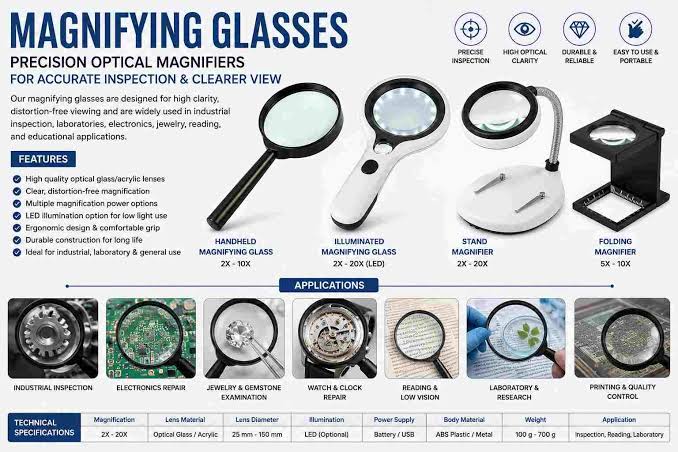
A magnifying glass is a simple yet powerful optical tool consisting of a convex lens—usually set in a frame with a handle—that produces a magnified image of an object. People primarily use a magnifying glass to enlarge small details so they can be examined more clearly with the naked eye. This makes it invaluable for reading fine print, inspecting collectibles, supporting hobbies, aiding low-vision needs, and enabling precise professional work. Understanding what a magnifying glass is used for reveals why this centuries-old device remains relevant in daily life, education, science, and specialized fields.
How a Magnifying Glass Works
A magnifying glass relies on a convex (converging) lens that is thicker in the center than at the edges. Light rays from an object pass through the lens and refract, or bend. When the object sits within the focal length of the lens, the lens creates a virtual, upright, and enlarged image. This allows the user to hold the object closer than the eye’s normal near point (typically about 25 cm or 10 inches for a healthy adult eye), increasing the angular size of the image on the retina and revealing finer details.
Magnification power is often expressed as a number such as 2×, 3×, or 5× and depends on the lens’s focal length and how the glass is positioned relative to the eye and object. Higher magnification usually means a smaller field of view and shorter working distance. The same convex lens can also concentrate sunlight into a hot spot, historically used for starting fires, though this requires caution due to fire risk.
Historical Context and Development
Evidence of magnifying devices dates back millennia. Archaeological finds include possible rock-crystal lenses from ancient Mesopotamia (around 710 BC, the Nimrud lens) and high-quality crystal lenses from ancient Crete. Classical writers such as Aristophanes (424 BC), Pliny the Elder, and Seneca described glass globes filled with water that enlarged text or could cauterize wounds. In 1021, Ibn al-Haytham (Alhazen) discussed the optics of convex lenses in his Book of Optics. By the 13th century, Roger Bacon described magnifying properties, and reading stones (plano-convex lenses placed on text) appeared in Europe. These developments paved the way for spectacles around the late 1200s and later for more advanced instruments like microscopes and telescopes.
The magnifying glass became culturally iconic, especially as a symbol of detective work (think Sherlock Holmes) and, in modern interfaces, as the search or zoom icon.
Primary Everyday Uses of a Magnifying Glass
Reading and low-vision support ranks among the most common applications. Many people use a handheld or illuminated magnifying glass to read small print in books, newspapers, medicine labels, maps, legal documents, or instruction manuals. Those with conditions such as macular degeneration, glaucoma, or age-related vision changes often rely on magnifiers (typically 3× to 10×) or stand-mounted versions for prolonged reading without eye strain. Illuminated models with LED lights improve contrast and reduce fatigue.
Hobbies and collecting benefit enormously. Stamp collectors (philatelists) and coin collectors examine fine details, printing quality, wear, and authenticity. Nature enthusiasts study insects, leaves, feathers, soil, or plant structures. Crafters and sewists use hands-free or stand magnifiers for needlework, embroidery, knitting, and detailed model-building. Map readers and puzzle solvers also find them helpful.
Professional and technical applications include jewelry appraisal and gemology (detecting inclusions, clarity, and craftsmanship), watchmaking and repair, dentistry, electronics inspection, textile and print quality control, and forensic or laboratory examination of small samples. Jewelers and watchmakers often prefer higher-power loupes held close to the eye, while larger handheld glasses suit broader inspection.
In education and science outreach, magnifying glasses serve as entry-level tools for observing specimens, conducting nature surveys (for example, examining a small quadrat of ground), and introducing optics concepts. They form the conceptual foundation for simple microscopes.
Types of Magnifying Glasses and Choosing the Right One
Common varieties include:
- Basic handheld models with a handle (versatile and portable).
- Illuminated versions with built-in lights.
- Stand or hands-free magnifiers for prolonged work.
- Sheet or Fresnel magnifiers (thin, lightweight, and useful for full-page reading).
- Higher-power loupes designed for close-up professional use.
- Clip-on or headband styles that free both hands.
When selecting a magnifying glass, consider magnification level (lower powers like 2×–4× offer wider fields and greater comfort for reading; higher powers suit detailed inspection), lens quality (to minimize distortion and chromatic aberration), size, weight, lighting needs, and whether hands-free operation is required. Optical-grade glass generally outperforms basic plastic for clarity, though modern acrylic and Fresnel designs are lightweight and affordable.
Tips for Effective Use and Modern Alternatives
Hold the magnifying glass so the object is within the focal length and adjust distance until the image is sharp. Good ambient or supplemental lighting dramatically improves results. Clean the lens regularly to avoid scratches and smudges. Avoid using it to stare at the sun or leave it in direct sunlight where it could focus rays and cause a fire.
While smartphone cameras with digital zoom, dedicated apps, and electronic video magnifiers offer modern alternatives, a traditional optical magnifying glass remains valued for its simplicity, lack of batteries (in basic models), true optical clarity without pixelation, and tactile reliability. Many professionals still prefer high-quality optical loupes or glasses for critical work.
Why Magnifying Glasses Endure
From helping someone read a prescription label to enabling a jeweler to authenticate a gem or a child to explore a leaf’s veins, a magnifying glass bridges the gap between the limits of human vision and the details of the world. Its uses span accessibility, recreation, education, and precision trades. By understanding what a magnifying glass is used for—and choosing the right type for the task—users gain a practical tool that has served humanity for centuries and continues to deliver clear results today.
Whether for everyday convenience or specialized inspection, the magnifying glass remains an accessible, effective, and enduring optical aid.



One thought on “What Is a Magnifying Glass Used For? A Complete Guide to Applications”