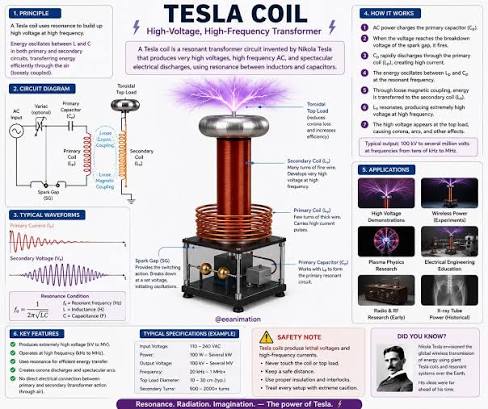
The Tesla transformator (also known as the Tesla coil or Tesla transformer) stands as one of Nikola Tesla’s most iconic electrical inventions. Patented in 1891, this air-core resonant transformer generates extremely high voltages at high frequencies, producing spectacular electrical discharges while enabling experiments in wireless energy, lighting, and early radio technology. Unlike conventional power transformers that rely on iron cores and operate at 50/60 Hz, the Tesla transformator uses resonance between loosely coupled circuits to achieve dramatic voltage step-up.
Historical Background of the Tesla Transformator
Nikola Tesla developed the device while pursuing efficient high-frequency alternating current systems and wireless power transmission. On April 25, 1891, he received a key patent covering the circuit. He publicly demonstrated it shortly afterward in a lecture before the American Institute of Electrical Engineers at Columbia College. Earlier work by researchers such as Henry Rowland on spark-excited resonant transformers provided context, yet Tesla refined the configuration into a practical, high-performance system that combined a high-voltage supply, capacitor, spark gap, and air-core oscillation transformer.
Tesla employed versions of the Tesla transformator in his laboratories for artificial lighting with gas-discharge tubes, X-ray research, high-frequency phenomena studies, and attempts at wireless energy transfer. Larger installations, including experiments in Colorado Springs (1899–1900) and concepts leading toward the Wardenclyffe tower, built on the same resonant principles. Early radio transmitters also used similar spark-gap Tesla systems until continuous-wave technology later dominated.
How the Tesla Transformator Works
A classic Tesla transformator consists of two magnetically loosely coupled LC circuits tuned to the same resonant frequency. A high-voltage power supply (often a conventional step-up transformer delivering several kilovolts) charges a primary capacitor. When the voltage reaches the breakdown threshold of a spark gap, the capacitor discharges through the primary coil, creating a rapidly oscillating current typically in the range of tens to hundreds of kilohertz.
The primary coil (usually a few turns of heavy conductor) induces energy into the secondary coil—a tall, single-layer winding of many hundreds or thousands of turns on an insulating form, often with a conductive topload (sphere or toroid) at the top. Because both circuits share the same resonant frequency, energy transfers efficiently and voltage multiplies far beyond the simple turns ratio through resonant rise. Peak voltages can reach hundreds of kilovolts or, in large systems, into the megavolt range, while average power remains modest (watts to a few kilowatts).
The absence of an iron core eliminates hysteresis losses and allows high-frequency operation. Output appears as corona, streamers, or long sparks that are relatively high-voltage but low-current, making carefully controlled demonstrations safer than equivalent low-frequency high-voltage sources—though significant hazards remain.
Key Differences from Ordinary Transformers
Standard power transformers transfer energy efficiently at line frequency using laminated iron cores and tight coupling. Voltage ratio closely follows the turns ratio. The Tesla transformator, by contrast, stores energy in resonant tank circuits and relies on loose coupling plus resonance for voltage magnification. This makes it unsuitable for continuous power distribution but ideal for generating high-frequency, high-voltage effects. Air-core design further distinguishes it from both iron-core and modern ferrite transformers used in switched-mode supplies.
Applications and Modern Relevance
Historically, Tesla transformators powered early wireless telegraphy transmitters and supported Tesla’s investigations into fluorescent lighting and atmospheric electricity. Today they serve primarily educational and entertainment purposes: science museums, physics classrooms, and specialty shows use them to illustrate resonance, electromagnetic induction, and high-voltage phenomena. Small versions still appear as vacuum leak detectors. Research continues into related resonant systems for specialized high-voltage testing and pulsed power.
Hobbyists and engineers build modern solid-state variants (using transistors or vacuum tubes instead of spark gaps) that offer greater control and reduced noise, yet the classic spark-gap design remains the clearest demonstration of Tesla’s original concept.
Safety, Limitations, and Legacy
High voltages, ozone production, electromagnetic interference, and fire risk demand strict safety practices, proper grounding, and distance from sensitive electronics. The Tesla transformator never became a practical everyday power device because of efficiency limits, radio interference, and the success of conventional AC power systems that Tesla himself helped pioneer.
Nevertheless, its conceptual influence endures. It demonstrated the power of resonance, contributed to radio technology foundations, and continues to inspire engineers and the public with vivid visual proof of high-frequency electricity. The name “Tesla transformator” remains standard in many European languages precisely because it captures both the inventor and the device’s transformer-like yet fundamentally resonant nature.



One thought on “Tesla Transformator”